Sunday, July 8, 2012

21. And Then There Were None by Agatha Christie


The story was definitely not hard to follow.  I did feel a little goofy at various parts.  Totally unrealistic but a good read.

1. Discuss the narrative techniques that Christie uses to create and maintain suspense throughout the novel.  One technique she used that I liked a lot is she got into the head of the characters and allowed us to hear what they were thinking.  I liked that very much.  Also, it's not just a long narrative she has little pauses in the narrative so that the reader can catch their breath.  The foreshadowing of Blore on the train I've seen that technique in other stories.  I call them little nuggets that keep the reader interested.

2. Discuss the role of the poem “Ten Little Indians” in And Then There Were None. Why does the murderer choose to follow the poem so closely? What effect does this have on the characters?   I think the "Ten Little Indians" just added a little flavor to Judge Wargrave's brand of murderous justice.  It made the character more weary and afraid.

3. Do you think that Wargrave acts justly? Why or why not?  I'm a believer in two wrongs don't make a right.  I think its good that Wargrave didn't take out his murderous lust on innocent people. But acting as an self-imposed executor is going to far.  On the other hand, I think society definitely didn't lose any Mother Teresa's with the killing of this bunch.  So to sum it up in the words of Chris Rock:  It's not right but I understand.  


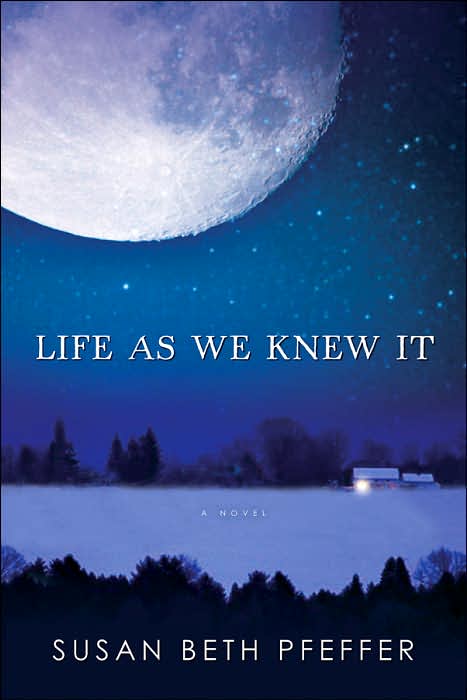
20. Life as We Knew It by Susan Beth Pfeffer


1.  Before the meteor strikes the moon, what are the biggest concerns in Miranda’s life? How do they change in the months that follow?  Miranda concerns are mostly high school teenager related.  The pressures of growing up dealing with homework, test, and friends.  Also her relationship with her dad and his new pregnant wife.  In the months that follow her biggest concerns are the basics: food, heat, water, and safety.  


2.  After Mrs. Nesbitt dies, Miranda goes through her kitchen cabinets and says doing so makes her “feel like a cannibal?” (p. 240) Why does she feel this way?   Mrs. Nesbit is dead probably not even cold yet and Miranda starts rummaging through Mrs. Nesbit house. I know life is about survival now but I thought she could at least tell her family say a prayer (even though she's not religious.)  I need a moment of silence at least.


3.  After the meteor strikes the moon, services such as telephone, Internet, and television stop, and Miranda writes in her journal that “Civilization had ended.” (p. 21) Do you think people are too dependent on electronic gadgets? Would you feel as Miranda does if you could no longer use 
the gadgets many people have come to depend on in their daily lives? How would you handle this situation?  Hell yeah!!!! I know I am.  When the electricity goes out for some reason I am completely at a loss.  You get so use to these gadgets that you feel attached to them.  I remember being without a microwave for a period of time.  I about lost my mind.  I think we as a people should have gadget free days just for a change of pace.  


4. How does Miranda feel about Megan’s religious convictions? (pp. 68–69) How does this affect their friendship? Do you think Megan’s faith is a good one?  Miranda thinks Megan is cuckoo and I would have to agree.  Faith shouldn't mean losing your common sense or your will to live.  They disagree on Megan's religious zeal and their relationship is ruined.


19. 145th Street Stories by Walter Dean Myers


What is especially odd about Big Joe’s funeral?  Why did he plan to have one?
Big Joe's funeral is odd because he is still alive.  He wanted to have a funeral while he was still alive in order to hear all the good things people had to say about him.  People never get their roses while they can still smell them.

What is The baddest dog in Harlem short story about?
The baddest dog in harlem shows how cops/outsiders perceptions of the ghetto affect how they act.  It shows the ramifications of those actions.  The killing of a innocent victim.  Sometimes external factors that people have no control over change the way people see a certain situation.

What observation does the narrator make about life on 145th street?  
He shows how life can be happy, fun, and beautiful at times but reality hits.  As in the fun with Big Joe's play funeral vs. the woman who experiences domestic violence comes to Big Joe later to ask for help.  It shows how the good times and bad times of life are interconnected.  The roller-coaster of life.

I liked the stories.  They were interesting and realistic.

Monday, June 11, 2012

18. The Descendants by Kaui Hart Hemmings


1.  After reading Kaui Hart Hemmings' The Descendants:  what was the main theme that you took away from it?  Forgiveness, the importance of family, and dealing with loss.  

2.  What was your favorite instance/scene in the novel vs. in the film?  Did your favorite scene change from book to movie?  No, my favorite scene is the same in both the novel and the film.  It is when Matt says goodbye to his wife telling her that she was his pain and joy.  Very touching scene.  

3.  Was a pivotal piece/scene left out of the movie that you wish had been included?  I think The Descendants movie portrayed the book pretty accurate.  The only big difference is Sid telling Julia about the affair instead of Brian.  Sid had a bigger role in the book but the exclusion in the movie is not a big deal.

Sunday, June 3, 2012

17. The Year of Magical Thinking by Joan Didon


1.  Consider the four sentences in italics that begin chapter one.  What did you think when you read them for the first time?  What do you think now?  When I first read those first sentences about how life changes so fast; my first thought was those statements are so true.  Life changes so fast that before you know it you are somewhere you never expected to be. You get so use to going through the motions that you forget how delicate life is until you get a reminder.

 2.  In particular, address "The question of self-pity."  Does Didion pity herself?  In what ways     
does she indulge that impulse, and in what ways does she deny it?  She allows her self to dwell on  the loss of her husband instead of moving on.  She thinks if she doesn't do things like throw out his shoes he still will be around.  She denies this by dealing with husband death by not falling apart.


Sunday, May 6, 2012

16. The Language of Flowers by Vanessa Diffenbaugh


1.  The first week after her daughter's birth goes surprisingly well for Victoria.  What makes Victoria feel unable to care for her child after that week ends? And what allows her to ultimately rejoin her family?    The baby needs more than Victoria feels she can give which makes Victoria feel inadequate.  She feels that she has to get away from the baby.  So she leaves the baby crying and she feels terrible.  Victoria never feels capable of being able to give love and receive love.  She realizes that she is capable and her past mistakes don't have to define her future.  

2.  The novel touches on many themes (love, family, forgiveness, second chances).  Which do you think is the most important?  And what did you think was ultimately the book's lesson?  All of the books themes are important.  I believe love is the most important because it is the basis for all the other themes.  Love is key in being in a family, forgiving, and getting second chances.  Love breaks all barriers.  The book's lesson is to believe in yourself and don't let your past define you.  Once realizes she doesn't have to live by what has happened in the past she can move on and learn to love her family.

3.  Based on your reading of the novel, what are your impressions of the foster-care system in America?  What could be improved?  The foster-care system has cracks in it and some kids like Victoria fall through it.  Some people abuse the system only seeing the kids as a paycheck.  The system is flawed mostly for kids who get a certain age and are lost in the system. More effort could be focused on helping these kids be more successful when they become adults.  

4.  Victoria and Elizabeth both struggle with the idea of being part of a family.  What does it mean to you to be part of a family.  What defines family?  Being a part of a family is like having an enormous support system that helps each other through life's ups and downs.  Family doesn't have to be blood-related they just have to love and support each other.

5.  What potential do Elizabeth, Renata, and Grant see in Victoria that she has a hard time seeing in herself? Because of the years she spent feeling unwanted and unloveable she think she doesn't deserve to be loved or to be a part of a family.  Elizabeth, Grant, and Renata try to show Victoria that she is wanted and is accepted into their family.  Victoria thinks she will mess up anyone she tries to love.  But they believe that she is capable of being anything she wants to be.

15. Defending Jacob by William Landay


1.  How would you have handled this situation if you were Andy?  Would you make the same choices he made?  Where would you differ the most?  Clearly, Jacob had some issues.  I understand the he wanted to defend his son but when it became obvious that Jacob committed murder Andy should have told the truth.  In telling the truth he might have been able to get Jacob the help he needed.  I don't have any children but if I did I hope I would always do the right thing. I know some parents would cover up for their children and even help them bury the body so to speak.  I would have turned Jacob over to the police and hope that he could get some kind of insanity plea.  So he could live in mental institution because he had severe mental problems.

2.  Before and during the trial, how would you have handled the situation if you were Laurie? Do you feel she made strong choices as a mother and a wife?  I would have broken completely down.  It would have been hard to know that your child is crazy violent.  You try your best to raise a responsible child and then it all falls apart.

3.  Is Andy a good father? Why or why not?  He loves his son that is clear.  I think deep down he knew his some committed the murder but he was so focused on defending him he refused to see the truth. I think part of being a good parent is always supporting your child but also calling them on it when they do things that are not right.

4.  Do you believe Jacob is guilty?  Hell yeah!!! In the beginning and the middle there are small doubts but at the end its apparent Jacob is guilty.

5.  Is Jacob a product of his upbringing?  Do you think he is a violent person because his environment makes him violent, or do you think he has violent inclinations from birth?  I think people are like a gumbo a variety of factors make they who they will become.  Biological elements are a huge part and we have no control over these.  Skin color, height, inclinations to be violent, kind, shy, talkative.  We have no control over these things.  Then throw these natural proclivities in with our surrounding environment which sometimes we have little control over also you have a recipe for a human being.   I believe you always have a choice in what you will become.  But negative biological and environmental inclinations are often insurmountable obstacles.   Also we must never use our situation as an excuse.  We must always push ourselves to be responsible human beings even if everything in our bodies seems to go against the society we find ourselves in.